Applied AI Case Study: Brightleaf Bakery
Concept exercise for the Google AI Professional Certificate — 8 applied projects and a self-contained JavaScript tool, built and deployed live.

- Client
- Fictional client, Google AI Certificate project
- Type
- Concept build
- Tools
- Google Gemini, WordPress, JavaScript
My role: Wrote and refined every prompt, evaluated Gemini’s raw output for accuracy and bugs, rewrote content into publish-ready copy, and hand-corrected real issues in AI-generated code (regex injection risk, whitespace handling) before treating it as production-ready.
Tools: Google Gemini, Google AI Studio. Google Docs, WordPress, and JavaScript
The challenge:
The raw AI output was often generic or had real gaps that needed catching, not just polishing. The initial partnership email buried the actual ask under filler language. The first brainstorm response was a flat, unstructured list of 16 ideas with no prioritization. Most notably, the AI-generated JavaScript for the readability checker had a regex injection vulnerability and a word-counting bug that would have miscounted on double-spaced text, both of which required manual correction and testing before the code could be considered production-ready.
The solution:
For each of the 8 certificate courses, I wrote a scoped prompt, evaluated Gemini’s raw response for accuracy, tone, and (in the case of code) functional correctness, then rewrote or corrected it into a publish-ready deliverable. Each exercise documents the prompt, the raw output, my edited version, and what I changed and why, showing the evaluation and revision work rather than just the AI output alone.
Proof it works:
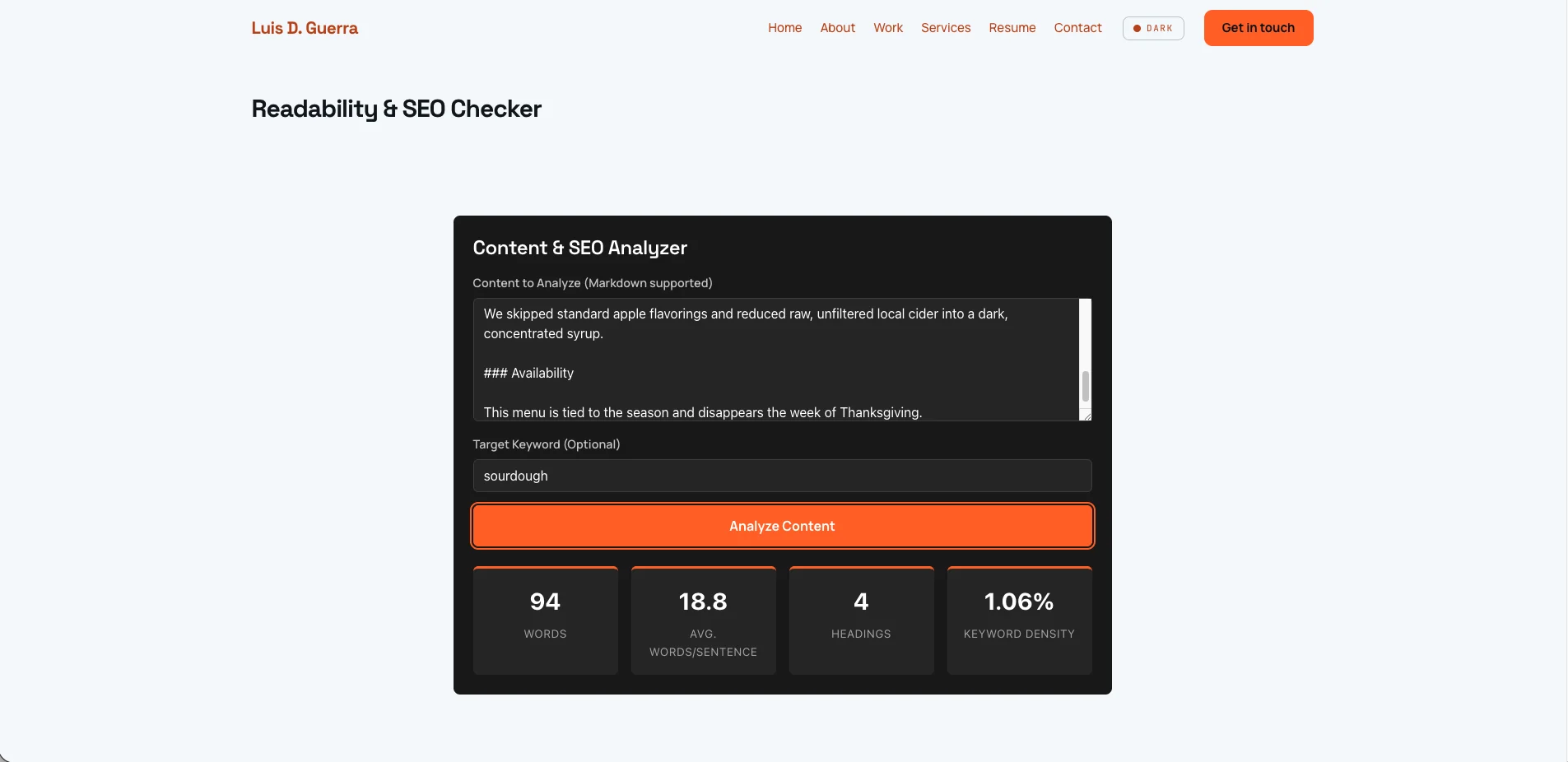
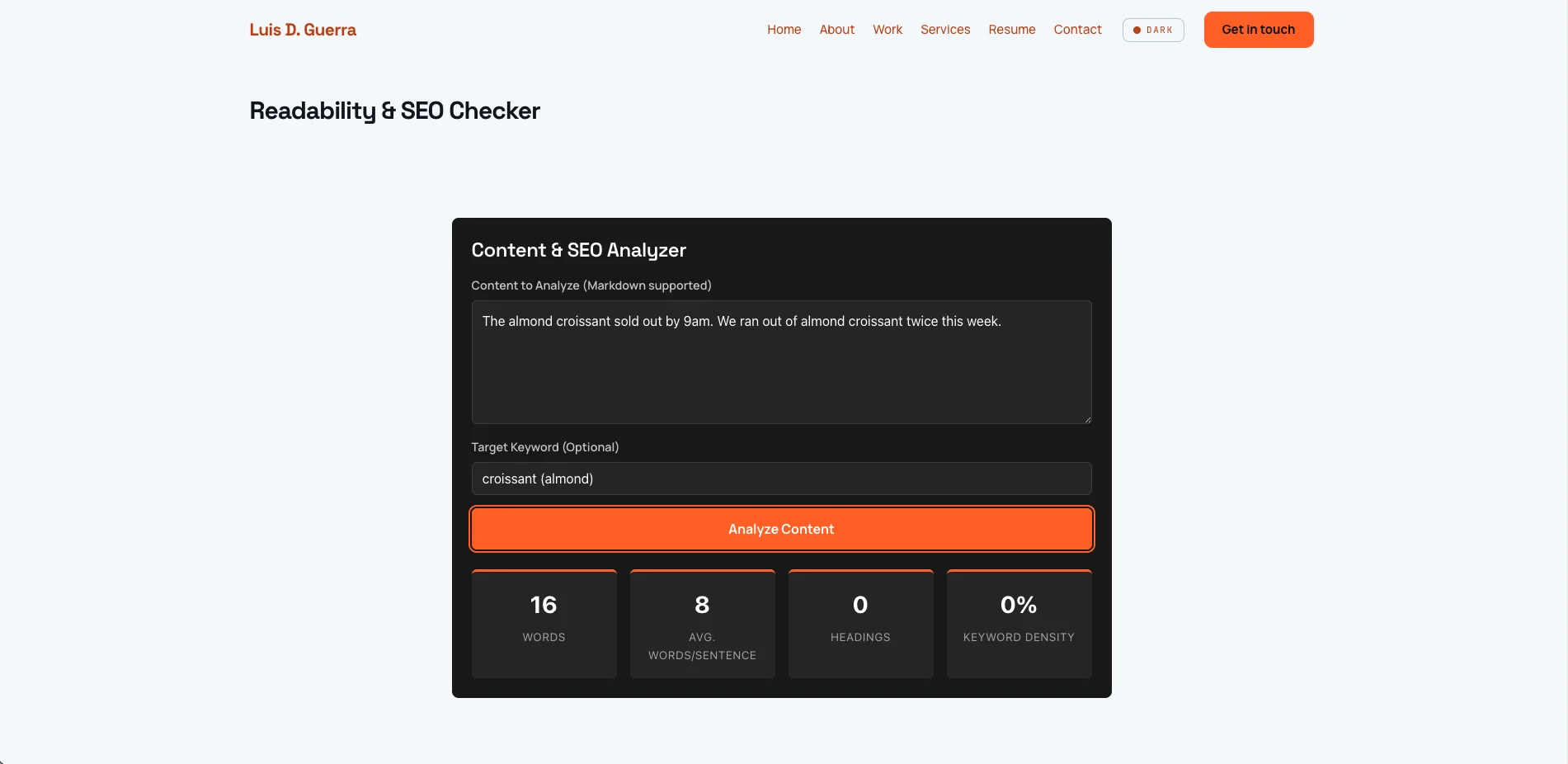
The screenshots below show the tool live on this page, the first analyzing a normal draft with a real keyword, the second testing the regex-injection fix directly, confirming a keyword containing special characters (croissant (almond)) doesn’t crash the tool.
Recommendation:
Treat prompt specificity itself as a code-quality lever, not just a starting point to review afterward. For any AI-assisted build going forward, write the edge cases into the prompt explicitly (as this spec did) rather than relying entirely on post-hoc testing to catch them. Testing remains necessary regardless, this result doesn’t replace verification, but it suggests upfront specificity reduces how much you’ll need to fix.
This is a concept build, not a client engagement.